



Two doors, two works of art, and a journey through the natural beauty, cultural traditions, and royal memories of Vietnam.
Luxury is often associated with beautiful surroundings, exceptional cuisine, and attentive service. Yet aboard Emperor Cruises Legacy Fai Tsi Long, luxury also reveals itself through the stories woven into the spaces guests encounter.
Inspired by the artistic sensibilities and refined lifestyle of Emperor Bao Dai, Vietnam’s last emperor, Emperor Cruises celebrates a philosophy in which art and heritage are essential parts of the journey.
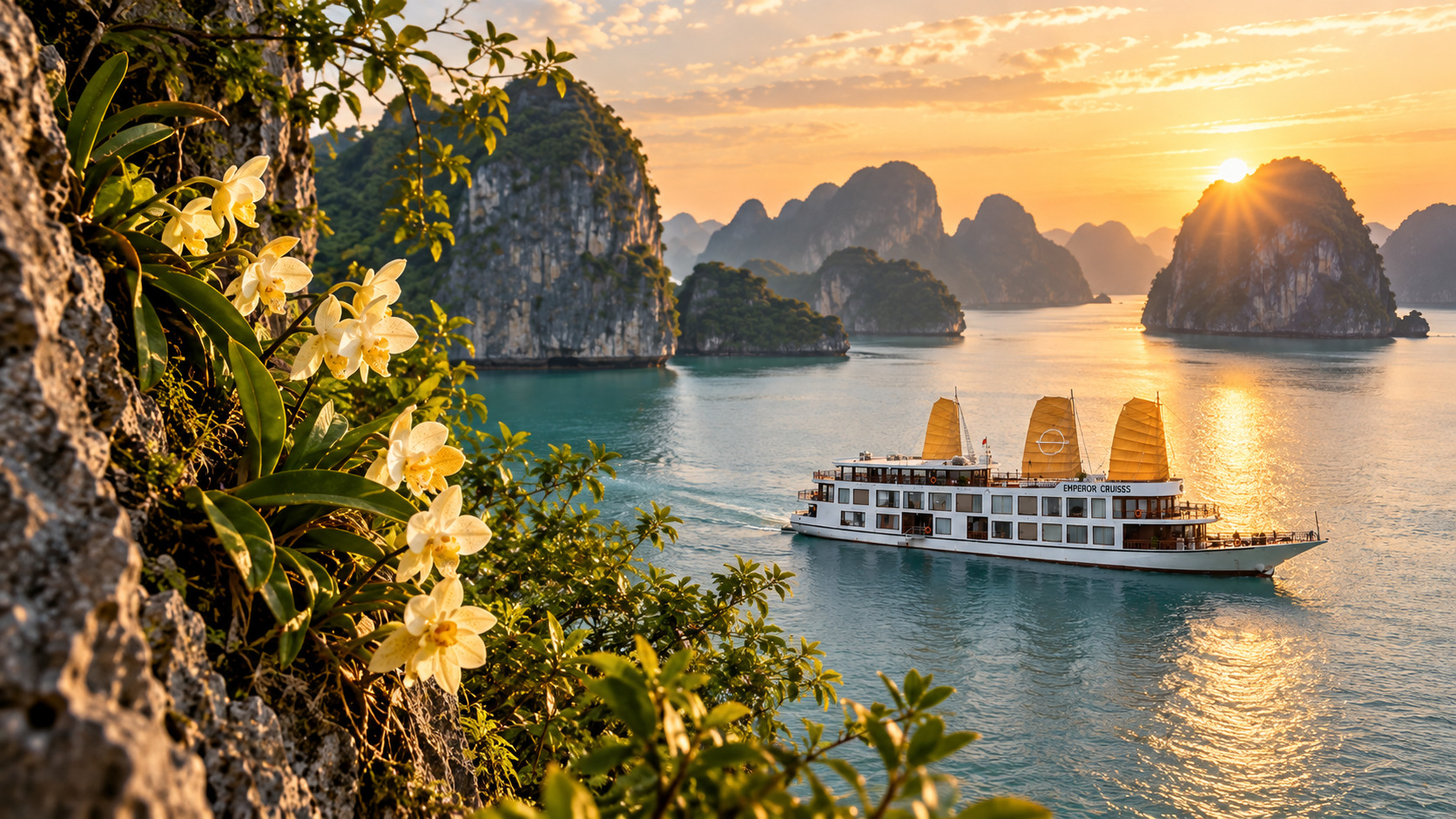
The Soul of Vietnamese Heritage begins with nature, where delicate orchids bloom against the majestic limestone cliffs of Ha Long Bay, reflecting the timeless beauty of Vietnam.
Among the vessel’s most meaningful artistic details are two works displayed near the entrances to Can Chanh Restaurant, the onboard dining space. One welcomes guests with an image of orchids growing along the limestone cliffs of Ha Long. The other accompanies their departure with an artistic representation associated with Quan Ho, the traditional folk singing of Bac Ninh.
Together, these works offer a thoughtful introduction to the soul of Vietnamese heritage, connecting the natural landscape of northern Vietnam with its cultural traditions and royal history.
The First Door: Where Nature Welcomes You
Before entering Can Chanh Palace, guests encounter an artwork depicting orchids growing against the dramatic limestone cliffs of Ha Long Bay.
The image captures a delicate contrast: flowers flourishing amid rugged stone formations shaped by nature over countless years.
Orchids have long been admired for their elegance and understated beauty. Set against the limestone landscape, they evoke the remarkable relationship between strength and delicacy found throughout Vietnam’s natural environment.

For guests exploring Bai Tu Long Bay aboard Emperor Cruises Legacy Fai Tsi Long, the artwork feels particularly meaningful.
Beyond the vessel, limestone islands rise from emerald waters, creating a landscape of extraordinary scale and quiet beauty. The bay’s secluded atmosphere offers opportunities to appreciate nature without the constant distractions of everyday life.
The painting brings a small part of that experience indoors.
It encourages guests to notice the details that might otherwise be overlooked: the shape of a cliff, the resilience of a flower, or the changing colors of the surrounding landscape.
Rather than simply decorating the entrance, the artwork establishes a connection between the environment outside and the cultural experience awaiting guests within.
It is a gentle reminder that the beauty of Vietnam begins with its land and waters.
The Second Door: A Farewell Through Vietnamese Cultural Heritage
At the departure entrance, another artwork introduces a different dimension of Vietnamese identity.
Associated with Quan Ho folk singing, the image draws attention to the cultural traditions of Bac Ninh, a province in northern Vietnam renowned for its distinctive musical heritage.
Inspired by the timeless Quan Ho melody “Người ơi, người ở đừng về” (Please Stay, My Dear), this artwork offers a heartfelt farewell, carrying the warmth and soul of Vietnamese hospitality.
Quan Ho is more than a form of traditional performance. Its melodies, exchanges between singers, and ceremonial customs reflect generations of community life, artistic expression, and human connection.

Recognized by UNESCO as an Intangible Cultural Heritage of Humanity in 2009, Quan Ho remains an important symbol of Vietnamese cultural identity.
Its presence aboard Emperor Cruises invites guests to consider the relationship between the nation’s artistic traditions and the lives of those who shaped its history.
One particularly intriguing connection leads to Bui Mong Diep, a woman born in Bac Ninh in 1924 who became closely associated with Emperor Bao Dai.
Her story opens a window into the personal world of Vietnam’s last emperor, beyond the familiar narratives of royal ceremonies and political events.
Bui Mong Diep: A Life Connected to Vietnam’s Last Emperor
As recounted in The Keeper of Greatness, Bui Mong Diep shared an important chapter of Emperor Bao Dai’s life.
Born in Bac Ninh, she later became one of the women most closely associated with the former emperor, accompanying him through periods of personal change and historical uncertainty.

The Soul of Vietnamese Heritage lives through Quan Ho folk singing, a UNESCO-recognized cultural tradition of Bac Ninh, where melodies and timeless customs preserve the spirit of Vietnamese culture.
Her relationship with Bao Dai extended beyond their private lives.
According to the account, she earned the affection and trust of Queen Mother Tu Cung, Bao Dai’s mother, and participated in certain royal ceremonial traditions.
One of the most significant episodes concerns the imperial treasures of the Nguyen Dynasty.
The book describes how Mong Diep was entrusted with the imperial gold seal, Hoang De Chi Bao, and subsequently carried it to France for its return to the former imperial family.
This episode offers a particularly compelling perspective on her place in royal history: a woman whose life became connected not only to an emperor, but also to the preservation and passage of objects symbolizing an entire dynasty.

The Soul of Vietnamese Heritage is reflected in the royal memories of Emperor Bao Dai and Bui Mong Diep, whose personal story connects Vietnam’s imperial history with the coastal landscapes of Nha Trang.
Her story was also marked by personal difficulties and separation, reflecting the complexities of Bao Dai’s relationships and the changing circumstances of the royal family.
For Emperor Cruises, this history offers an opportunity to explore the human stories behind Vietnam’s royal heritage.
The connection between the Quan Ho artwork and Mong Diep is therefore a cultural and historical interpretation, rooted in their shared association with Bac Ninh, rather than a claim that the painting portrays her directly.
Royal Memories by the Sea: Bao Dai and Nha Trang
The story of Emperor Bao Dai and Bui Mong Diep also leads south to Nha Trang, a coastal destination closely associated with the former emperor’s leisure and seaside retreats.
According to the historical account, Bao Dai and Mong Diep spent time together at the Cau Da villas overlooking the waters of Nha Trang.
Photographic materials attributed to researcher Nguyen Dac Xuan are described as documenting moments from their coastal life, including time aboard boats and visits to seaside residences.
These details reveal another side of Bao Dai: a man who appreciated travel, natural scenery, and the pleasures of life beyond formal royal settings.
The sea was part of that world.
Nha Trang’s sheltered bay, surrounding islands, and coastal landscapes offered an environment suited to relaxation and private enjoyment.
Today, this historical association provides a meaningful context for the experiences offered by Emperor Cruises Legend and Emperor Cruises Origin in Nha Trang Bay.
Inspired by Bao Dai’s appreciation of art, culture, and refined living, Emperor Cruises brings a contemporary interpretation of Vietnamese boutique luxury to the waters associated with his seaside memories.
The intention is not to recreate royal life exactly as it once existed, but to carry forward its appreciation for beauty, thoughtful hospitality, and meaningful experiences.
When Art Becomes Part of the Journey
The two artworks at Can Chanh Palace reflect a broader philosophy behind Emperor Cruises.

Art is not treated merely as an ornamental addition to an elegant interior. It becomes a means of connecting guests with the destination, its people, and its cultural history.
The orchid painting celebrates Vietnam’s natural beauty.
The Quan Ho-inspired artwork opens a conversation about the country’s living traditions and the people whose stories remain connected to them.
Between these two images lies a wider narrative embracing landscapes, music, personal memories, and royal heritage.
Guests may discover these connections while walking through the vessel, enjoying Vietnamese cuisine, admiring the surrounding bay, or speaking with members of the crew.
Such encounters give an intimate boutique cruise its distinctive character.
With just ten suites aboard Emperor Cruises Legacy Fai Tsi Long, the experience encourages a slower, more personal appreciation of the destination.
The cultural details are there to be noticed and explored, allowing guests to engage with Vietnamese heritage naturally throughout their journey.

The Soul of Vietnamese Heritage Lives in Its Stories
When guests first enter Can Chanh Palace, they are welcomed by an image of flowers growing among limestone cliffs.
When they leave, they encounter an artistic reminder of Vietnam’s cultural traditions.
The journey between these two doors may last only a few steps, yet the stories they represent extend across generations and regions of the country.
From the limestone landscapes of northern Vietnam to the melodies of Bac Ninh, from the memories of Emperor Bao Dai to his seaside retreats in Nha Trang, each connection contributes to a richer understanding of Vietnamese identity.
At Emperor Cruises, these stories are part of the experience.
They remind us that heritage is not confined to museums or history books. It continues to live through art, places, traditions, and the memories we choose to preserve.
And sometimes, discovering the soul of Vietnamese heritage begins with something as simple as walking through a doorway.
Based on conversations and interviews with Dr. Pham Ha
Written by Nguyen Thi Quynh Anh – Marketing Manager